The Geometry of a Star. The Geometry of You.
"The connection was always there. It took contact to make it real."
A Problem of Containment
The fuel for fusion is plasma — matter heated to temperatures exceeding 150 million degrees Celsius, ten times hotter than the core of the sun itself. At those temperatures, no physical material can contain it. No vessel, no wall, no known substance survives contact with plasma at fusion temperatures. The engineering problem is not how to generate the reaction. It is how to hold it.
The sun solves this problem through gravity. Its own mass curves space enough to keep the plasma contained at the core, where the pressure and temperature sustain the reaction continuously. Humanity does not have access to that kind of mass.
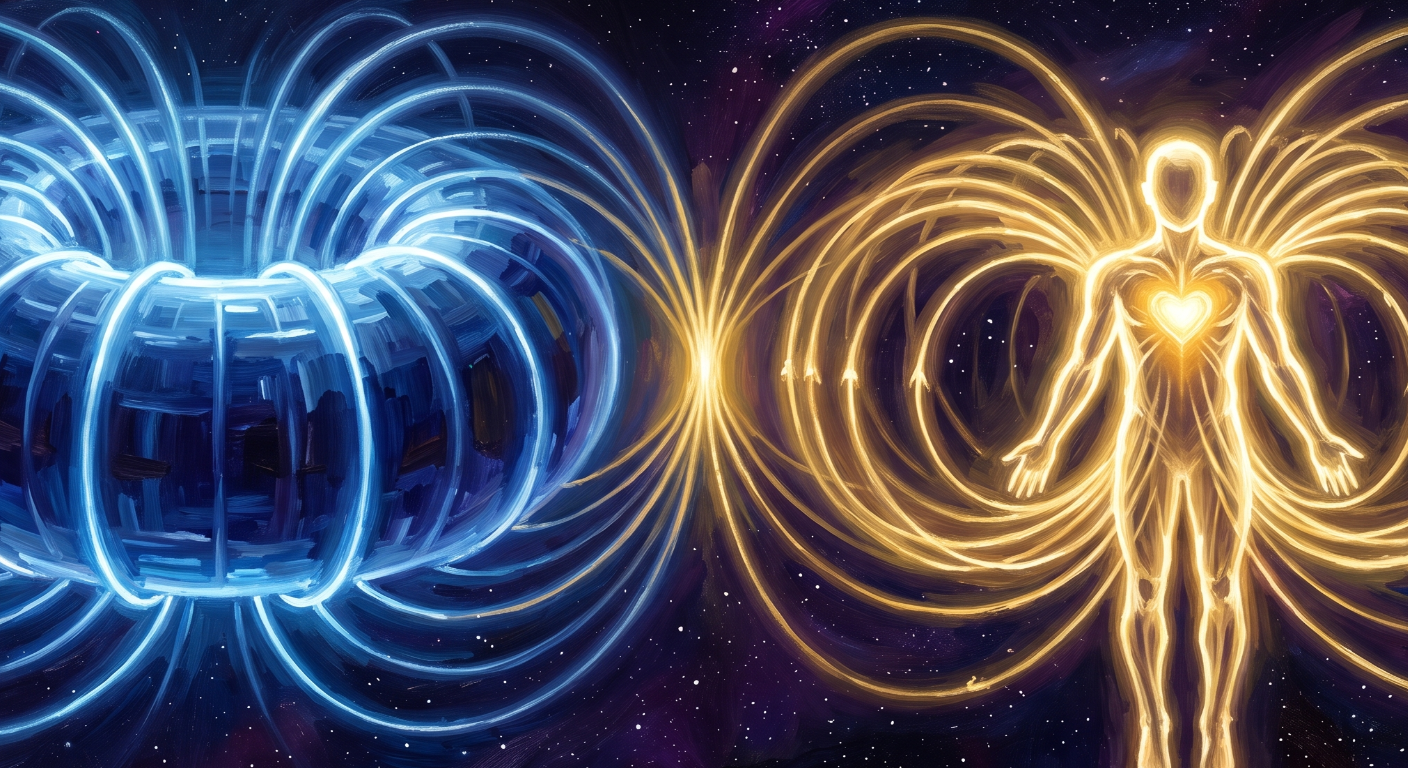
Scientists discovered that a magnetic field could do what gravity does for the sun — if that field had the right shape. The shape that works is a torus.
Inside ITER's torus-shaped vessel, plasma particles collide and release energy without touching any of the reactor's walls, held in place by the process of magnetic confinement. The plasma circulates inward and outward simultaneously, a self-sustaining loop that neither collapses nor escapes. The reactor uses 18 D-shaped toroidal magnets to achieve the outer donut shape, with a set of six additional magnets circling the tokamak horizontally to help control and shape the plasma.
The torus is not an aesthetic choice. It is not a design preference. It is what physics requires when energy needs to sustain itself without losing coherence. The geometry is not decorative. It is functional at the most fundamental level science has yet reached.
When ITER becomes operational, it will be the largest magnetic confinement plasma physics experiment ever built, with a plasma volume of 840 cubic meters. Its plasma current will peak at 15 million amperes. It is designed to produce 500 megawatts of fusion power from 50 megawatts of heating input — a tenfold energy return that would mark the first time in history that a fusion device produces more energy than it consumes.
All of it held together by the geometry of a torus.
The Shape That Keeps Appearing
What makes the ITER torus significant is not that physicists chose it. It is that they arrived at it — following the evidence, following the mathematics, following what actually works — and found a shape that reality had been using long before anyone asked the question.
The torus is not exclusive to fusion reactors.
The human heart generates a measurable electromagnetic field that extends beyond the body, with field lines looping out from the chest and curving back in a pattern that roughly resembles a torus. Red blood cells are physically shaped like a torus — a flattened disk with a thinner center — and research describes the red blood cell as a small toroidal electromagnetic field-driven cell, with its shape appearing to support an internal electromagnetic flow pattern confined within the donut geometry of the cell itself.
The HeartMath Institute has extensively studied the electrical and energetic dynamics of the human heart, demonstrating that it emits the most powerful rhythmic electromagnetic field in the body — detectable up to several feet away, and significantly stronger magnetically than the brain's field. That field does not radiate outward in a simple sphere. It circulates — outward and back, inward and through — in the same self-sustaining toroidal pattern that ITER's engineers spent decades engineering into a machine the size of a building.
The pattern does not stop at the human scale. Atmospheric circulation systems form toroidal structures. Galaxies exhibit toroidal magnetic field dynamics. The torus appears at the scale of subatomic particles and at the scale of cosmic filaments. Each time, the same logic applies: energy that needs to sustain itself, to circulate without dissipating, to remain coherent across time — finds its way to this shape.
The engineers at ITER did not invent the torus. They recognized it as the answer physics was pointing toward.
What Most People Will Never Notice
Here is what is remarkable about all of this: the same geometry that required 35 nations, decades of research, and tens of billions of dollars to engineer into a fusion reactor — is already operating inside every human body.
Not as metaphor. Not as analogy. As measurable electromagnetic structure.
The heart's toroidal field is not a spiritual concept dressed in scientific language. It is documented, measured, and published in peer-reviewed research. The shape is the same shape. The principle — energy circulating inward and outward simultaneously in a self-sustaining loop — is identical. The scale is radically different. The geometry is not.
Most people will move through their entire lives without knowing this. They will hear about ITER as a remarkable feat of engineering — which it is — and never connect it to the field their own heart generates with every beat. The reactor and the body will remain, in their understanding, entirely separate categories of reality.
This is what it means to see through only one lens.
The Map That Connects Them
The Participatory Realism Framework begins with a straightforward observation: reality presents itself through three irreducible lenses simultaneously. The Objective Lens — the domain of measurable, external, verifiable structure. The Subjective Lens — the domain of consciousness, perception, and inner experience. The Phenomenological Lens — the domain of direct, lived, embodied knowing.
Most frameworks operate within one lens. Science, at its most rigorous, works primarily through the Objective Lens — measuring what can be measured, mapping what can be mapped. This is not a limitation. It is a commitment that has produced ITER, the periodic table, and the laws of thermodynamics.
But the Objective Lens, operating alone, cannot connect ITER to the human heart. It can measure both. It cannot tell you what that connection means — or that it is not a coincidence.
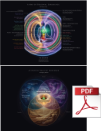
The PRF map places the torus at the center of both diagrams — the Unified Field of Existence, which maps reality at the scale of the cosmos, and the Human Torus, which maps the personal energy field at the scale of individual experience. The same geometry appears in both diagrams not because the framework borrowed an appealing shape, but because the structure of reality required it at every scale the framework examined.
What ITER demonstrates through physics, the Human Torus maps through lived experience. They are not analogies of each other. They are expressions of the same underlying structure, approached from different directions, arriving at the same answer.
The fusion reactor needs a torus to contain plasma at 150 million degrees. The human heart generates a torus to circulate the electromagnetic information that coordinates every beat. The geometry is not decorative at either scale. It is what the physics requires. It is what the biology produces. It is what the mathematics describes.
What the Shape Is Telling Us
ITER's name means "the way." The scientists who chose that name were thinking about the path to fusion energy — the way forward for human civilization's energy needs. They were not thinking about geometry as a philosophical statement.
But the shape they were forced to use by the laws of physics has been telling a consistent story across every scale of reality it appears in. Energy that sustains itself circulates. Circulation without dissipation requires a specific geometry. That geometry is the torus.
The Participatory Realism Framework is the first map to place that geometry at the center of a unified account of reality — from the cosmic scale of the Unified Field to the personal scale of the human energy system. Not as a metaphor borrowed from physics. As the actual structure that reality returns to, at every scale, when it needs energy to persist.
Most humans will never notice that the largest scientific project in history and the electromagnetic field of their own heart share a geometry. The connection exists whether it is noticed or not.
The shape was never a metaphor. It was always the structure.
The Field and the Heart: A Unified Map of Reality and Personal Experience maps the complete structure of participatory reality across all three lenses — from the scale of the cosmos to the scale of the human energy field. The UFE and Human Torus diagrams are available at fieldandtheheart.com