Participation Changes Reality. The World Cup Is Proving It.
How the 2026 World Cup became an accidental field experiment in participatory reality
Across American cities this summer, something is being documented in real time that has little to do with soccer. Visitors from dozens of countries — arriving with fixed mental models of what America is, built from distance, media, and political narrative — are reporting the same unexpected experience. Their perception changed. Not through argument. Not through new information. Through contact.
This is not a feel-good sports story. It is a live demonstration of how reality actually works.
What People Are Reporting
The accounts are consistent enough to constitute a pattern.
Scottish supporters in Boston placed traffic cones on statues — a cultural act so specifically Scottish, so cheerfully irreverent, that Americans stopped and laughed alongside them. A joke became a bridge. The humor didn't need translation because the humanity underneath it did not require one. What arrived was not information about Scotland. It was Scotland, present, participating, genuinely itself.
In Texas, Japanese fans encountered barbecue — not as a culinary category but as a full embodied event. The smoke, the ritual of the pit, the particular unhurried Texas relationship with meat and time. The felt experience of that encounter carried something no documentary about American food culture could have delivered. The body received what the mind had only approximated before.
And in Lawrence, Kansas — perhaps the most precise demonstration of the pattern — something more structural occurred. Lawrence became the host city for the Algerian national team. The city did not simply accommodate the visitors. It reorganized itself around the encounter. University groups activated to expand community awareness about Algeria. Local businesses learned what Algerian visitors needed and reshaped their offerings accordingly. The city studied its guests. Lawrence became, for the duration, a different version of itself — more curious, more porous, more alive to the world beyond its own prior frame.
What is being reported across these encounters is not surprise at American hospitality specifically. It is surprise at the collapse of a prior certainty. The mental model — America is this, Americans are that — held with genuine conviction, built over years of careful attention to information, simply dissolved under the weight of direct experience.
The perception did not change because someone argued the case. It changed because participation made argument unnecessary.
What the Objective Lens Carries
The Participatory Realism Framework identifies three irreducible lenses through which reality presents itself. The first is the Objective Lens — the domain of measurable, external, verifiable reality. Science. Structure. Information.
The prior perception of America that visitors arrived with was an Objective Lens construction. Carefully assembled from data points: news cycles, political reporting, social media, the accumulated testimony of others who had not been here either. This is not a criticism of those perceptions — the Objective Lens is real and its information is not wrong. America's political divisions are documented. Its inequalities are measurable. The data exists.
But the Objective Lens, operating alone, produces a map that mistakes itself for the territory. The map is accurate as far as it goes. It simply does not go far enough.
What Contact Activates
The third lens — the Phenomenological Lens — is the domain of direct, lived, embodied experience. Not information about reality. Reality as it is encountered from the inside.
When a visitor steps into an American crowd carrying a flag from another country and is met not with hostility but with genuine curiosity — when a stranger leans over and asks where they are from, not as a challenge but as an opening — something happens that the Objective Lens map did not predict and cannot fully account for. The body knows before the mind catches up. The felt experience arrives first. The conceptual revision follows.
This is the phenomenological lens activating. Direct contact overriding prior construction. The territory correcting the map in real time.
The correction is not that the prior information was false. It is that information was never the whole picture. The human field that exists between people — the capacity for genuine contact that operates beneath political identity, national narrative, and cultural assumption — was always there. The World Cup created the conditions for participation to make it visible.
The Torus at Scale
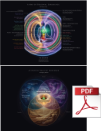
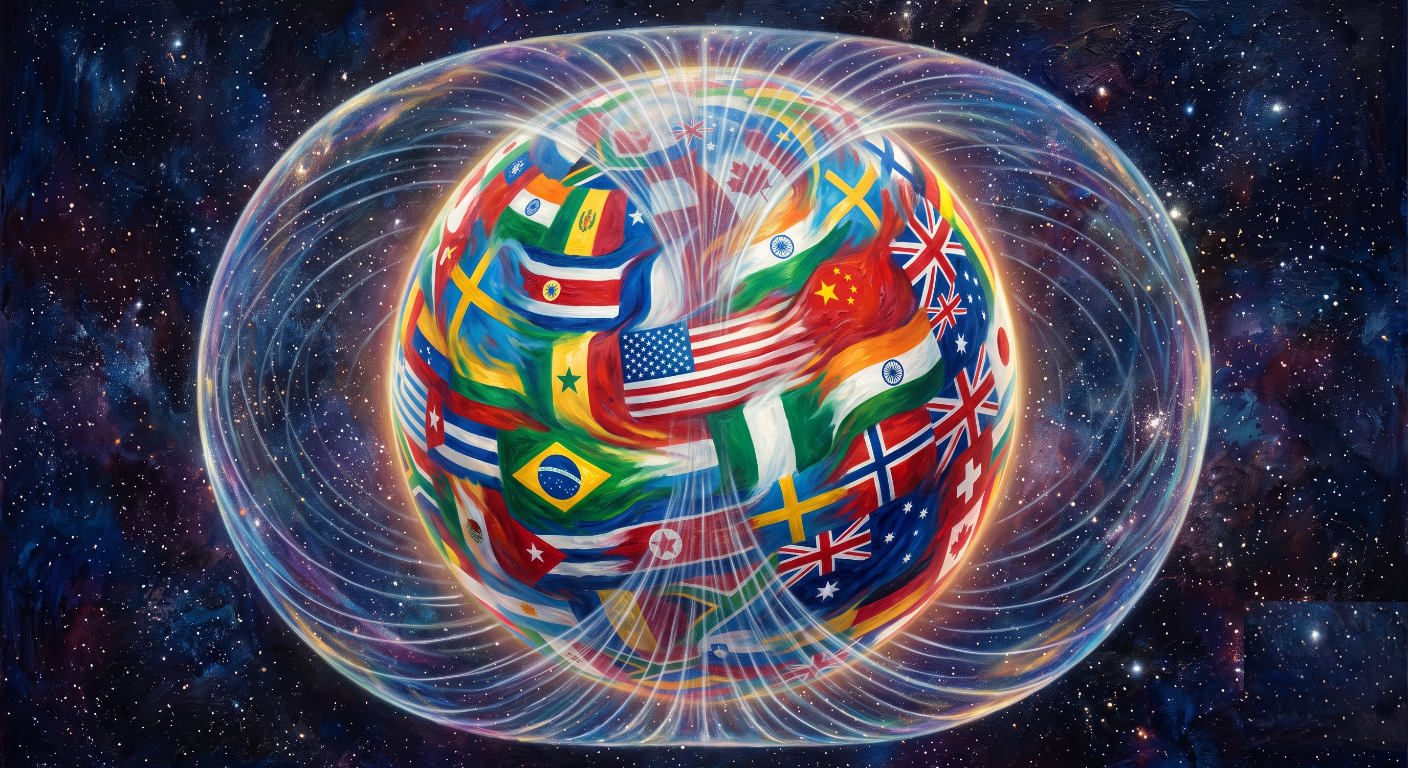
The Participatory Realism Framework describes reality as fundamentally toroidal in structure — energy moving inward and outward simultaneously in a self-sustaining circulation. What is being observed across American World Cup host cities is the torus operating at social scale.
Visitors arrive carrying openness — the particular receptivity that travel produces, the temporary suspension of defended identity that comes with being a stranger in an unfamiliar place. That openness generates a response. Lawrence, Kansas is the clearest example. The Algerian team arrived. The city responded. The response generated deeper Algerian engagement with the city. That engagement generated deeper civic reorganization. The circulation became self-sustaining — each movement inward producing a corresponding movement outward, the torus completing itself through participation rather than plan.
This is not sentiment. It is structure. The torus does not require agreement, shared values, or prior relationship. It requires participation. When enough people participate with genuine attention — when they stop observing from a distance and enter into contact — the field that was always latent becomes active.
The positive energy amplifying across these cities is not being manufactured. It is being uncovered.
What This Demonstrates
The World Cup will end. The visitors will return home carrying revised perceptions that their prior information could not have produced. The Americans who encountered them will carry something too — a reminder of what becomes visible when the defended social structure temporarily relaxes and contact becomes possible.
What this moment demonstrates is not that people are fundamentally good, or that political division is superficial, or that sport has healing power. Those are interpretations. The demonstration is more precise than any of them.
Reality is participatory at its core. The potential for genuine human connection — across language, culture, national identity, and political narrative — does not have to be created. It already exists as potential in the field. What collapses that potential into actual experience is not better information, not correct argument, not shared ideology.
It is participation.
The connection was always there. It took contact to make it real.
The Field and the Heart: A Unified Map of Reality and Personal Experience maps the complete structure of participatory reality across all three lenses. Available at fieldandtheheart.com