The Map Is Not the Territory
A first encounter with Participatory Realism
At some point most people notice that the instructions don't quite cover everything.
Not in a dramatic way. Just a quiet persistent sense that the life you were told to build keeps running out of explanations exactly where the most important questions begin. What is this actually for. Why does doing everything right still feel like something is missing. What is going on beneath the surface of ordinary life that nobody seems to talk about directly.
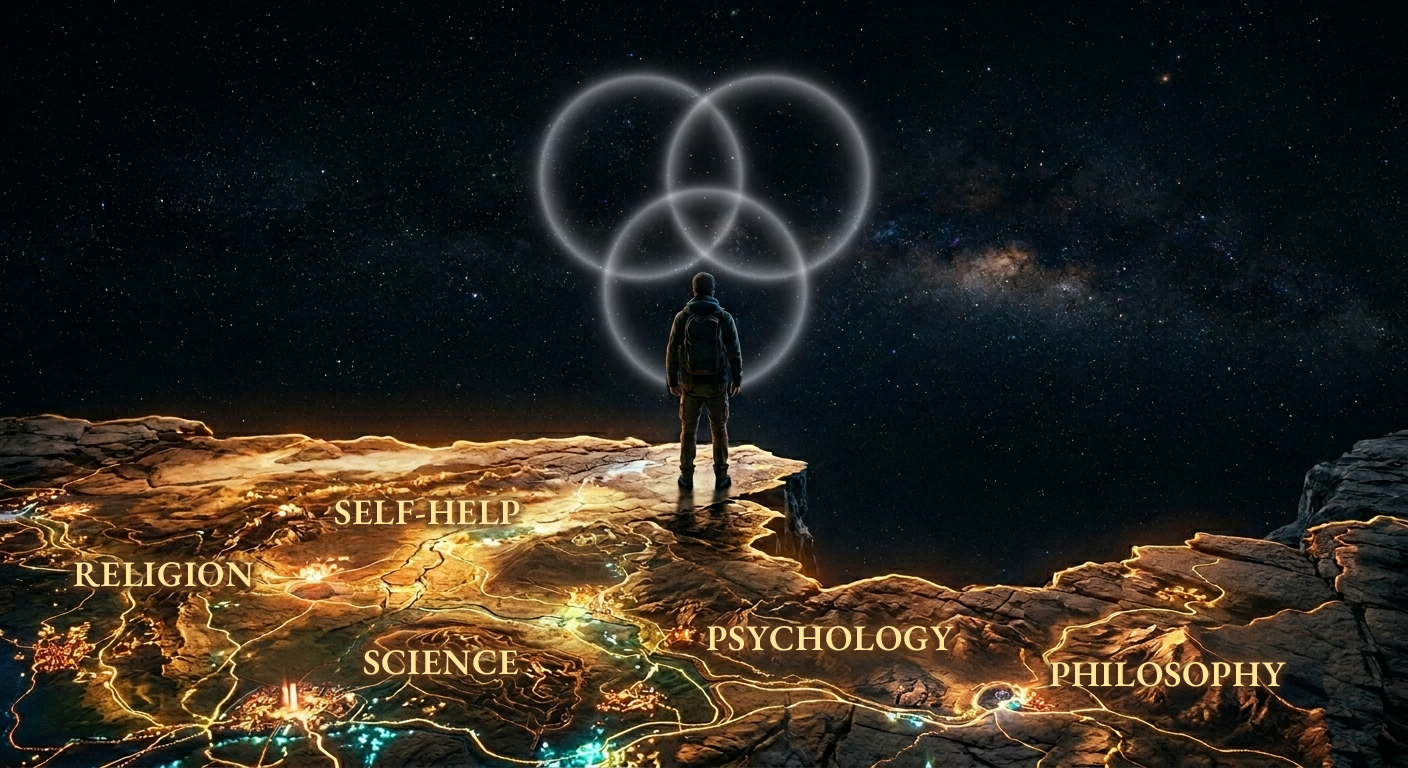
That feeling is the territory. Your actual life. The things that happen to you that don't fit the categories you were given. The experiences that the map says shouldn't be there.
We All Inherit Maps
The religion you grew up with is a map — it tells you what reality is made of, what matters, what happens when you die. The self-help book you read at a turning point is a map — it tells you who you are, what went wrong, how to fix it. The scientific worldview most of us absorbed through school is a map — it tells you what's real and what isn't, what counts as evidence, what questions are worth asking.
None of these are wrong. A good map is genuinely useful. The problem isn't the map. The problem is when your actual life keeps showing you things the map doesn't have words for — and instead of questioning the map you start questioning your own experience.
Most people file those questions away. Life is busy. The map mostly works. You learn to stay in the parts of your life it covers.
Some people can't do that. Not because something is wrong with them — because they're paying attention to something real. The map keeps failing in the same place and they keep noticing. That noticing is not a problem to solve. It's a philosophical disposition. It's the beginning of honest inquiry.
The Gap Between the Map and Your Life
There's a line from The Matrix that captures this precisely. Morpheus tells Neo there's a difference between knowing the path and walking the path. He's not talking about effort or discipline. He's talking about the gap between any description of your life and your life itself. Every map, no matter how accurate, is still just a map. Your actual experience is always larger than any representation of it.
Most frameworks — religious, philosophical, psychological — are very good maps. They name things clearly. They give you language for your experience. They describe the terrain ahead.
What they can't do is close that gap. And most of them don't admit the gap exists.
If you've been quietly looking for a more honest map, here is what it would need to include.
What an Honest Map Would Need
It would need to hold three irreducible ways of knowing simultaneously — the scientific, the inner, the lived — without ranking them or collapsing one into another. Your life isn't fully visible from any single angle. A complete map requires all three lenses open at once.
It would need a center that is a process rather than a destination. Most maps have a top — an enlightened state, a fully realized self, a final answer. An honest map doesn't. Because your life doesn't have a top. The process doesn't complete. Any map that promises arrival is already misrepresenting the terrain.
It would need to build its own limitation into its structure. Not as a disclaimer but as a design principle. The map that knows its own edges is the only map worth trusting at the edges.
Participatory Realism is that map. Not a path to walk. Not a practice to adopt. Not a promise about where you'll arrive. A cartographic document of the life you are already living.
The field is real. The heart is real. The participation is real.
What you do with that is yours.
The Field and the Heart: A Unified Map of Reality and Personal Experience by Kurt Schramer explores these questions in full.