The Three Lenses on the Bridge: Kirk, Spock, and Bones as a Model of Integrated Consciousness

Gene Roddenberry created a lot of things when he created Star Trek. He created a vision of a future in which humanity had survived itself. He created some of the most durable science fiction characters in popular culture. And — almost certainly without intending to — he created one of the most precise dramatic illustrations of integrated consciousness ever put on screen.
The dynamic between James Kirk, Mr. Spock, and Dr. Leonard McCoy is not merely good character writing. It is a working model of what the Participatory Realism Framework calls the three irreducible lenses of reality — and it is worth examining closely, not only because it illuminates the characters, but because it resolves something the framework itself needs to say more clearly.
A Tension Worth Naming
The Participatory Realism Framework, as developed in The Field and the Heart, makes two claims about its three lenses that can appear to be in tension.
The first claim is that the three lenses are separate and equal — genuinely irreducible modes of engagement with reality, none of which can be derived from or substituted by the others. The Objective lens sees what the Subjective lens cannot. The Subjective lens illuminates what the Objective lens cannot reach. The Phenomenological lens accesses what neither of the others can touch. In this sense they are peers. No hierarchy.
The second claim is that the Phenomenological lens — the lens of lived experience — embodies the other two. Not that it is superior to them. But that it is the ground on which the others land — the only lens capable of receiving both structure and meaning without abstracting them into something less than they are.
These two claims are not contradictory. But they require careful unpacking to see why. The Kirk/Spock/Bones triad is the clearest illustration of how they fit together that popular culture has produced — and it does so without ever using the vocabulary of the framework at all.
Three Characters, Three Lenses
The Objective lens engages reality through structure, pattern, measurement, and logical inference. It is the lens of science, of systems, of what can be demonstrated independently of the observer's feelings about it. Its power is precision and reliability. Its limitation is that it brackets the first-person entirely — and in doing so, it cannot account for what the structure is for, or what it means to the beings who must live within it.
The Subjective lens engages reality through values, meaning, consciousness, and the interior life. It is the lens of ideals, of moral conviction, of what ought to be. It is concerned with the inner architecture of experience — with what a person believes, what they hold sacred, what they are willing to fight for. Its power is its moral clarity and its commitment. Its limitation is that values without structural grounding can become rigid, and conviction without embodied contact with the situation can mistake principle for wisdom.
The Phenomenological lens engages reality through direct embodied knowing — the intelligence that lives not in propositions or ideals but in the full reception of a situation as a living human being within it. It is the lens of presence, of felt consequence, of the wisdom that cannot be abstracted without being lost. Its power is its integrative capacity: it can receive both structure and values as lived information — not as data to be processed but as reality to be inhabited. It is the ground lens, not because it outranks the others, but because it is the only lens that can hold the others without losing what makes them real.
Spock is the Objective lens. Bones is the Subjective lens. Kirk is the Phenomenological lens — and in being so, he is also the site of the framework's participatory collapse.
Spock: The Objective Lens
Spock's function on the Enterprise is not merely to provide data. It is to embody a particular mode of engagement with reality — one that is genuinely powerful and genuinely limited in equal measure.
His power is precision. Spock sees the structure of situations with exceptional clarity precisely because he has disciplined himself to exclude emotional interference. He can calculate odds, identify patterns, and reach logical conclusions that no purely feeling-based intelligence could arrive at. In a crisis this is not a small thing. The universe does not reorganize itself according to what we wish were true, and Spock's insistence on what is demonstrably the case is often the thing that prevents disaster.
His limitation is equally precise. A consciousness that has fully bracketed the first-person has also bracketed the question of what the structure is for — what it means to the beings who must live within it. Spock's recommendations toward the logically optimal outcome frequently involve a casualness about individual human life and suffering that the other characters find — correctly — to be incomplete. He is not wrong about the structure. He is missing the layer of reality that the structure exists to serve.
The framework is explicit on this point: the Objective lens sees with exceptional clarity precisely because of what it has chosen not to see. That is not a flaw to be corrected. It is the nature of a lens.
Bones: The Subjective Lens
If Spock represents what can be known through structure and inference, Bones represents something different from what is usually assumed. He is not primarily the emotional counterweight to Spock's logic — though he functions that way dramatically. He is the embodiment of the Subjective lens: the domain of values, consciousness, moral conviction, and what it means to be human as an ideal rather than merely as a fact.
Bones knows what people should be treated as. He carries a fierce and non-negotiable conviction about the value of individual life — not derived from calculation, not produced by embodied contact with a particular situation, but held as a fundamental orientation toward existence. I'm a doctor, not a — is not merely a catchphrase. It is a values statement. It is Bones asserting the primacy of a particular ideal against whatever structural or situational pressure is attempting to override it.
His moral force is the show's conscience. When Spock recommends the logically optimal action and that action involves treating people as variables in an equation, it is Bones who names what has been left out — not as a structural counter-argument but as a values protest. He is not saying Spock is factually wrong. He is saying that the facts Spock is working with are missing the most important fact of all: that the people involved have irreducible worth that no calculation can capture.
His limitation mirrors Spock's in the opposite direction. Values without structural grounding and without full embodied presence in the situation can become rigid. Bones' conviction about what ought to be can lead him to resist what is — to fight the structural reality of a situation rather than navigate it. His ideals are the show's moral anchor. They are not, on their own, a navigation system.
Kirk: The Phenomenological Lens and the Participatory Collapse
Kirk is not smarter than Spock. He is not more principled than Bones. He occupies a different position entirely — and understanding that position resolves the apparent tension in the framework's two claims about the Phenomenological lens.
Kirk's defining capacity is full reception. When Spock presents the structural analysis, Kirk receives it — not as data to be filed but as lived information about the reality of the situation. When Bones protests from his values, Kirk receives that too — not as emotional noise to be managed but as equally real information about what the situation actually contains. He does not privilege one over the other. He does not average them. He holds both, fully, in the body of a human being who must act.
This is the Phenomenological lens functioning at its highest capacity. It is not a third perspective added to the other two. It is the capacity to receive the other two without abstracting them — to let structure and values both land in lived experience rather than processing them from a distance. The Phenomenological lens is the ground lens precisely because it is the only lens capable of this. Structure can be felt. Values can be embodied. But neither the Objective nor the Subjective lens can fully receive the other without the Phenomenological ground beneath them.
And then Kirk acts. Not from logic, not from principle, but from the participatory center that becomes available when all three lenses are genuinely present and in tension. His famous intuition — the gut feeling that overrides the odds, that finds the solution Spock couldn't calculate — is not irrationality. It is what the framework calls the collapse into Participatory Realism: the moment when full reception of a situation, through all available lenses, produces a quality of engagement that none of the lenses could have reached independently.
Kirk is the Phenomenological lens. And the Phenomenological lens, when fully developed, becomes the participatory center. That is not a contradiction. That is the framework's deepest claim.
Resolving the Tension
This is where the Star Trek triad earns its philosophical keep.
The three lenses are separate and equal in their epistemic domain. What Spock sees, Bones cannot derive from his values. What Bones holds as conviction, Spock cannot calculate into existence. What each lens sees is genuinely unavailable to the others. In that sense they are irreducible peers — no hierarchy, no substitution possible.
But they are not equal in their integrative capacity. The Objective lens cannot receive the Subjective without converting values into variables — which is precisely what Bones protests when Spock does it. The Subjective lens cannot receive the Objective without filtering it through its ideals — which is precisely what makes Bones resistant to structural realities that conflict with what he believes ought to be true. Neither lens can hold the other without distorting it.
The Phenomenological lens can. Not because it is superior — it has its own limitations, its own blind spots — but because lived experience is the only domain in which structure and values can both be present simultaneously without being reduced to each other. Kirk holds Spock's analysis and Bones' conviction in the same moment, in the same body, without resolving the tension prematurely. That capacity — full reception without premature resolution — is what makes the participatory collapse possible.
The two claims in the framework are therefore both true, and they are true at different levels of description. At the level of what each lens sees: separate and equal. At the level of integrative capacity: the Phenomenological lens is the ground. It does not see more. It holds more. And in holding more, it makes the center available.
What This Means Beyond the Bridge
The Kirk/Spock/Bones triad is compelling not because it is a clever character dynamic but because most people recognize it from their own inner life.
Most of us have a dominant lens. The person who leads with analysis and finds embodied presence difficult is living primarily in the Objective. The person who leads with moral conviction and finds structural complexity frustrating is living primarily in the Subjective. The person who is most at home in full presence with a situation — who receives rather than processes, who acts from the integrated center rather than from a single perspective — is living closest to the Phenomenological ground.
Integration is not the elimination of the dominant lens. Spock does not need to become Kirk. Bones does not need to become Kirk. Integration is the expansion of the field's available range — the cultivation of genuine access to all three lenses, and through that access, the increasing availability of the participatory center that their convergence makes possible.
The Enterprise bridge is a diagram of that possibility. Three irreducible modes of engagement, in genuine relationship, held by a ground intelligence capable of receiving all of them — producing a quality of navigation that none of them could achieve alone.
Roddenberry called it a starship. The framework calls it integrated consciousness. The structure is the same.
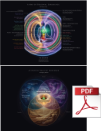
This article applies the Participatory Realism Framework developed in The Field and the Heart: A Unified Map of Reality and Personal Experience to cultural analysis, and extends the framework's account of the relationship between the three lenses.