You Are the Observer-The Matrix as a Map of Participatory Reality
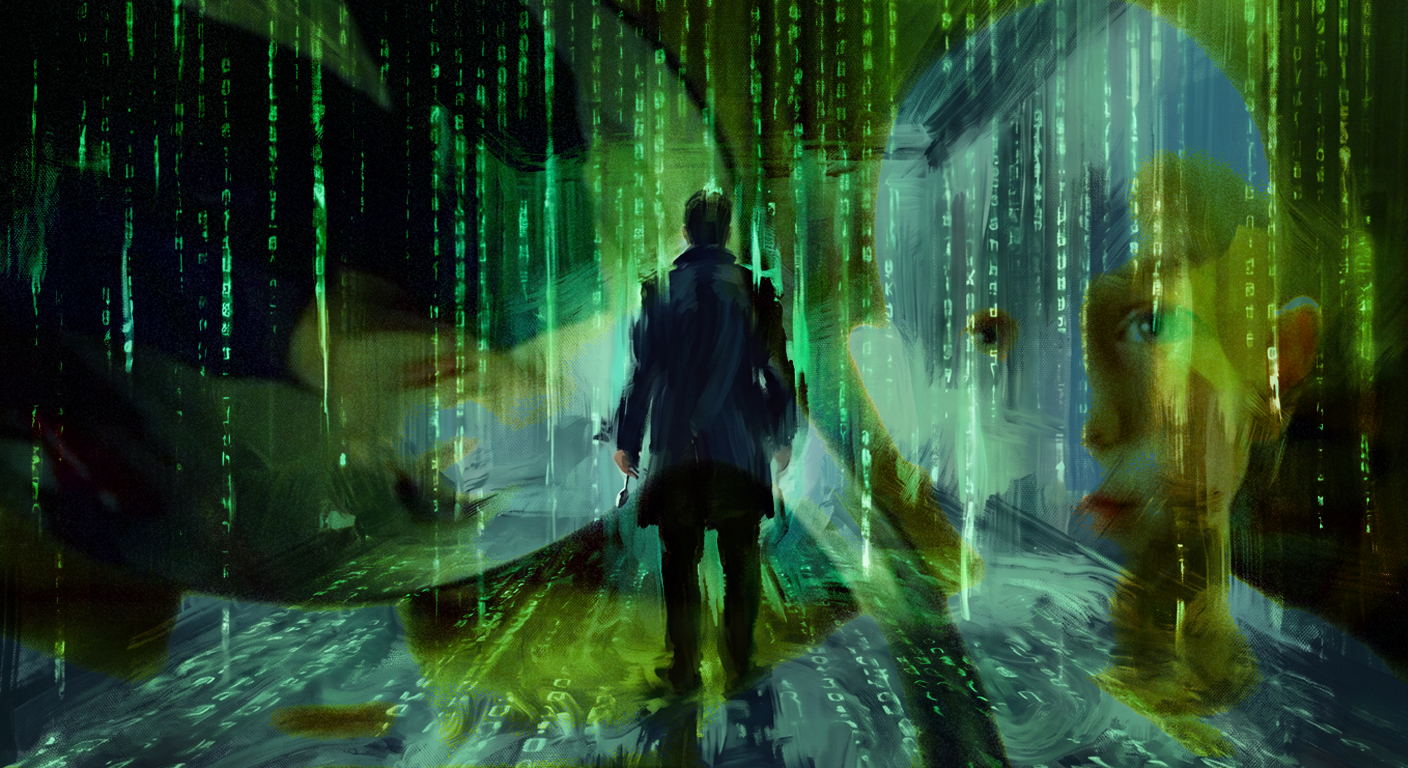
There is a scene early in The Matrix that most people remember as a cool philosophical moment and then move past. A child sits on the floor of the Oracle's waiting room, bending a spoon with his mind. He hands it to Neo and offers what sounds like a Zen koan: "Do not try to bend the spoon. That's impossible. Instead, only try to realize the truth — there is no spoon."
Neo tries. The spoon bends.
Most readings of this scene treat it as an introduction to the film's central premise: the physical world is a simulation, therefore its rules can be broken once you know they aren't real. The spoon isn't there, so you can bend it. Reality is fake, so you can hack it.
This reading is almost right — but it misses the deeper claim. And missing it means missing what the Wachowskis were actually building across the film's three hours.
The child doesn't say the spoon isn't real. He says there is no spoon as a fixed, observer-independent object. That is a different and far more interesting statement. It isn't nihilism about reality. It's a precise claim about the nature of the relationship between observer and observed — that what we call reality is not a stage we passively watch but a participatory event we are actively constituting.
Philosophers have a name for this position. This essay calls it Participatory Realism.
The World the Wachowskis Built
Before we follow Neo to his moment of seeing, it's worth noticing that the Wachowskis didn't just put a philosophical idea inside an action film. They built the entire architecture of their world around three distinct modes of engaging with reality — and the dramatic tension of the film is generated precisely by the collision between them.
The first is the Objective world. The hovercraft Nebuchadnezzar. The power plant. The pods. The measurable, verifiable, physical truth of what the Matrix actually is — electrical signals fed into neural inputs, biological bodies in gestation pods, machines running on harvested energy. This is reality as structure, as measurable fact, as system. Morpheus and his crew inhabit this world. They know the code. They know the statistics. They know the architecture of the machine civilization with scientific precision. When Tank is at the operator console reading the Matrix's code, he is functioning as a pure Objective-lens observer — reality as information, as pattern, as data.
The second is the Subjective world. The Matrix itself. A reality that exists entirely within consciousness — a shared construction generated by minds, experienced as real by the minds inside it, and indistinguishable from physical reality by any subjective test available from within it. The Matrix is pure idealism made cinematic. It is the philosophical thought experiment of Descartes' evil demon and Berkeley's "to be is to be perceived" rendered in green-tinted code and slow-motion action sequences. Everyone inside the Matrix is living proof that consciousness can generate a complete and convincing reality with no objective substrate whatsoever — or rather, with an objective substrate (the actual physical world) that is completely invisible from inside the subjective experience it produces.
The third is the Phenomenological world. This is the most important and least discussed of the three — the world of lived experience as such. The world Mouse defends when he argues about what the taste of chicken actually means. The world Cypher chooses when he accepts re-insertion into the Matrix in exchange for the felt experience of a good steak. "I know this steak doesn't exist. I know that when I put it in my mouth, the Matrix is telling my brain that it is juicy and delicious. After nine years, you know what I realize? Ignorance is bliss." Cypher is not stupid and he is not simply a traitor. He is someone making a phenomenological argument — that the felt quality of experience is real regardless of its substrate, and that a life of genuine felt pleasure is worth more to him than a life of objective truth in grinding misery. He is wrong about the choice, but he is not wrong about the ontological weight of lived experience. The phenomenological lens does not yield to the objective. What it feels like to be alive is not a secondary fact about reality. It is primary data.
The three worlds of The Matrix are not three plot settings. They are three irreducible lenses on reality — and the film's drama is the drama of a man learning to hold all three simultaneously.
The Moment Everything Changes
Neo sees the code for the first time as he is dying.
He has been shot by Agent Smith in the hotel corridor. Trinity has told him he cannot be dead because the Oracle told her she would fall in love with the One, and she loves him. He stands up. And then — he sees it.
The Matrix dissolves. Not into darkness or void, but into cascading streams of luminous green code. The agents, the walls, the floor, the corridor — all of it becomes transparent. All of it becomes readable. He sees Smith and the other agents as what they are: patterns of code, dense and fast-moving, but patterns. Configurations in a participatory field. And he knows — not as a thought but as a direct perception — that he is not subject to those patterns. He participates in their constitution.
This moment has been discussed endlessly. The standard reading is that Neo finally believes — that the shift is one of faith overcoming doubt, confidence overcoming hesitation. He stopped trying to be the One and became the One. It's a hero's journey reading, and it's not wrong, but it operates entirely within the Subjective lens. It's a story about a change in inner state.
What PRF reveals is that something more precise is happening. Neo doesn't simply believe differently. He perceives differently. He has moved from being an observer of a fixed reality to being a participant in a reality he is co-constituting. The code he sees is not the "true reality beneath the illusion." It is reality becoming transparent to a consciousness that has finally inhabited what this framework calls the participatory center — the convergence point where the Objective (the code, the structure, the system), the Subjective (consciousness, awareness, perception), and the Phenomenological (the immediate felt present of standing in that corridor) are all operating simultaneously and in full coherence.
This is why enlightenment traditions speak of non-duality not as the disappearance of the world but as the transparency of the world. The Zen master doesn't stop seeing the wall. The wall stops being opaque. It becomes what it always was — a pattern in a field that consciousness is participating in constituting — rather than an independently fixed object that consciousness passively receives. The rock is still hard. But its hardness is no longer an absolute brute fact. It is one face of a participatory event.
Neo doesn't discover that the Matrix isn't real. He discovers that he is participating in its reality. This is a completely different and far more significant realization.
The film Hollywood-izes this moment — as it must, this is a studio action film — by immediately translating the perceptual shift into superhuman combat capability. He stops bullets. He reaches into Smith and detonates him from the inside. The participatory insight becomes a power fantasy. This is the necessary price of the medium. But if you watch the scene carefully, what precedes the action is a stillness. A moment of pure perception before the movement begins. That stillness is the real event. Everything else is the trailer.
Three Characters, Three Lenses, One Arc
The Matrix follows a character pattern that turns out to be one of science fiction's most reliable philosophical structures. (In a previous essay on this site, we explored how Gene Roddenberry embedded the same architecture into the three leads of Star Trek — Kirk, Spock, and Bones as Phenomenological, Objective, and Subjective respectively, functioning as an integrated consciousness. The Matrix gives us a variation on this structure that is worth examining on its own terms — because unlike the Star Trek triad, which shows three lenses held in stable balance by three distinct personalities, the Matrix triad shows us something more dynamic: three characters who together enact a movement toward integration across the arc of the entire film.)
Morpheus is the Objective lens — but not in the way Tank is. Tank reads the code. Morpheus reads the system. He is the one who knows the facts of the situation with absolute clarity: the history of the war, the architecture of the Matrix, the nature of the prophecy, the statistical reality of their odds. His faith — and it is worth noting that Morpheus is almost always described in terms of faith — is not irrational. It is a commitment to what the Objective lens has shown him is structurally true. The prophecy is real. The One is coming. The system can be broken. He knows these things the way a scientist knows a verified theory — with the kind of certainty that is actually the Objective lens operating at high coherence. His limitation is the limitation of the Objective lens: he cannot account for the data that arrives through the other two. When Neo finally acts, Morpheus has to revise his entire model. That revision, that willingness to update even foundational beliefs in the face of new experiential data, is the Objective lens at its best.
Trinity is the Phenomenological lens — and this is why her role is more philosophically significant than most readings acknowledge. She is not Neo's love interest with a slightly larger action role. She is the validation mechanism of the entire system. The Oracle's prophecy threads through Trinity: she will fall in love with the One, and the One cannot be dead if she loves him. This is not sentiment. It is a precise claim about the epistemological authority of lived felt experience. When Trinity tells Neo he is alive and she loves him, she is making a phenomenological argument that takes priority over the objective evidence of his body having been shot multiple times. The felt truth of present experience overrides the measurable data of apparent death. And she is right. The phenomenological lens does not yield to the objective lens when the two are in genuine conflict. It delivers data the objective lens cannot access.
Neo is neither of these. He is the participatory center — but he has to earn it across the film's arc. At the beginning he is entirely in the Subjective lens: a mind in a simulation, dimly aware that something is wrong, living in pure inner experience with no framework for understanding it. The red pill moves him into the Objective lens — the brutal physical reality of the hovercraft, the body with its neural plug, the machine civilization. He spends most of the film oscillating between these two lenses, unable to integrate them. He knows the Matrix is a simulation and he can still be killed inside it. He knows the prophecy but cannot feel its truth in his body. The moment of seeing the code is the moment all three lenses converge. He has the Objective clarity of Morpheus (he sees the structure), the Phenomenological immediacy of Trinity (he is present in his body in this corridor in this moment), and the Subjective awareness of what consciousness actually is and does. Participatory Realism is not a theory Neo adopts. It is a state he inhabits. And once he inhabits it, the rules of the system become permeable — not because the system has changed but because he is no longer merely subject to it.
The Oracle and Focused Attention
There is one more element of the film worth examining through the PRF lens, and it is the element that most unsettles viewers who think carefully about it: the Oracle.
The Oracle doesn't predict the future. She participates in its constitution.
When she tells Neo he is not the One, she is not making a false prediction. She is making a precise calibration. Neo at that moment is not the One — he is a man who needs to choose, needs to move through the full arc of loss and sacrifice and recognition, before the participatory state becomes available to him. Telling him he's the One at that point would short-circuit the process. It would give him the Subjective belief without the Phenomenological grounding. He would try to bend the spoon.
The Oracle is operating from the participatory center herself. She knows that focused attention — where and how a consciousness directs its awareness — participates in constituting what becomes actual. She doesn't reveal futures. She shapes trajectories of attention, knowing that the trajectories will generate the futures. When she mentions the vase before Neo knocks the vase off the counter, she is not reading a fixed timeline. She is participating in one.
This is what the principle of focused attention means in the Unified Field framework: not that positive thinking creates reality, not that believing something makes it true, but that consciousness is not a passive receiver of a pre-constituted world. It is an active participant in what becomes actual. The quality, direction, and coherence of attention genuinely shapes what the participatory event of experience produces.
The Architect, by contrast — that cold gray figure in the white room surrounded by screens — is the Objective lens in its most seductive and most dangerous form. He offers Neo complete information. Total systemic understanding. The entire history of the Matrix's previous iterations, Neo's statistical position within the system, the precise calculus of choices and outcomes. And this information, delivered with absolute Objective-lens clarity, is designed to make Neo feel that choice itself is an illusion. The system is already determined. The variables are already known.
Neo walks away. This is not a rejection of knowledge. It is a recognition that the Objective lens, even at maximum resolution, cannot access the participatory dimension. All the information the Architect possesses is real. And none of it determines what a consciousness inhabiting the participatory center will choose.
A Note on Energy
One detail of the film's premise that has not received the philosophical attention it deserves: the machines didn't choose to harvest human beings arbitrarily. They chose to harvest beings with self-sustaining toroidal energy fields.
The human body generates a toroidal electromagnetic field — energy ascending from the earth through the physical body, descending from higher consciousness through the crown, the two flows meeting at the heart and circulating in a self-sustaining loop that extends outward and returns. This is not science fiction. It is measurable. The HeartMath Institute has documented the heart's electromagnetic field extending several feet beyond the physical body, responsive to emotional state, carrying coherent signal at high frequency and incoherent noise at low.
The machines, in the film's premise, discovered that this self-sustaining circuit — the human torus running in its pod, unconscious but generating — is an energy source that persists without external input once established. They are not harvesting electricity from batteries. They are siphoning the outer return loop of a toroidal field that sustains itself through its own circulation. Neo's liberation is not only a political act. He reclaims his field.
The Spoon, Again
We should return to where we started.
The child says: "There is no spoon."
Participatory Realism says something more precise, and I think more true: the spoon is real, and your perception is real, and what we call the spoon is the event that happens at their meeting. You do not need to deny the spoon. You do not need to decide that physical reality is an illusion and consciousness is all there is. You need to stop treating yourself as a passive receiver of a fixed reality and start recognizing yourself as a participant in its constitution.
The Matrix is a film about a man who makes that shift. Across three hours of action, philosophy, love, betrayal, and resurrection, Neo moves from being someone things happen to into someone who participates in what happens. That movement — from subject of a system to participant in a field — is what enlightenment traditions have been describing for millennia, in languages ranging from Sanskrit to Sufi Arabic to the quantum physics of John Wheeler.
The Wachowskis wrapped it in leather and slow-motion bullet time and made it the highest-grossing film of 1999.
It worked because the idea it contains is true.
You are not in the Matrix. You are the Observer — the focused attention through which potential becomes experience, through which the participatory event of reality constitutes itself moment by moment. The code is already there. Learning to see it is the work.
Curious how this pattern appears elsewhere in science fiction's most beloved characters? The essay The Three Lenses on the Bridge looks at how Star Trek's Kirk, Spock, and Bones embody the same three-lens structure — and why their integration aboard the Enterprise is one of television's most precise maps of human consciousness.