Both Sides Now: Joni Mitchell's Three-Lens Map of Reality
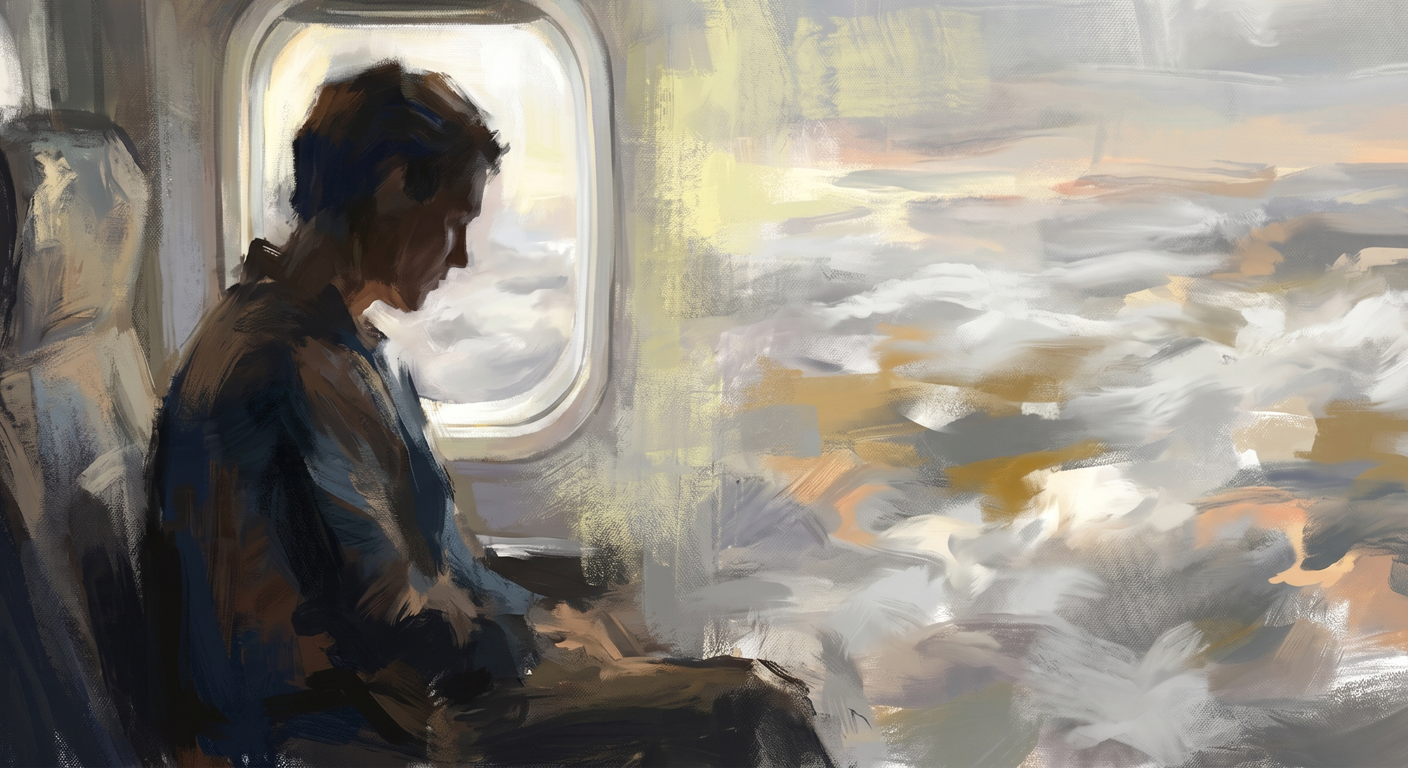
Joni Mitchell wrote "Both Sides Now" at twenty-three, on a plane, reading Saul Bellow, looking out the window at clouds. She had just finished a passage in which a character looks up at the sky from the ground and sees it as a vast, beautiful thing. Mitchell looked down at the clouds from above and realized they looked completely different from up here — lumpy, obstructing, ordinary. The same clouds. Two completely different realities depending on where the observer stood.
She wrote the song in the air and landed with one of the most philosophically precise pieces of popular music ever recorded.
Most readings of "Both Sides Now" treat it as a song about disillusionment — a young romantic discovering that clouds, love, and life are more complicated and less beautiful than she imagined. The final line of each verse, "I don't know life at all," is typically read as resignation: the earned humility of someone who has looked at things from both sides and found that neither side tells the whole story.
That reading is not wrong. But it stops at the surface of what Mitchell actually built.
What she built — whether she knew it or not — is a precise map of three irreducible lenses through which human beings engage with reality. And the final "I don't know" is not the same in each verse. It changes. And what it changes into, by the third verse, is not defeat. It is arrival.
The First Verse: The Objective Lens
The song opens with clouds — but not clouds as romantic backdrop. Mitchell approaches them as an observer approaches a system: with wonder at their structure, their patterns, their apparent meaning. She describes their formations with the attention of someone who believes that if you look carefully enough at the thing itself, it will tell you what it is. Ice cream castles. Feathered canyons. Angel hair. The clouds are objects in the world, and if you study them with sufficient care and openness, they will yield their nature.
This is the Objective lens in its most innocent and generous form — the belief that reality is knowable through careful, attentive observation of what is actually there. Science begins here. Wonder begins here. The conviction that the world has a structure, and that the structure can be seen, is not naivety. It is one of the three irreducible truths about how reality can be engaged.
But then something shifts. The clouds that looked so full of meaning and structure — castles, angels, the promise of rain — turn out to be more ambiguous up close. They block the sun. They obstruct the view. The structure she was so certain she could read turns out to be more complicated, more resistant to interpretation, than the first careful looking suggested.
And she arrives at her first "I don't know."
This is the Objective lens reaching its limit. Not failing — reaching the boundary of what any single mode of observation can access. The clouds are real. The wonder was real. The careful looking was real. And it still didn't tell her everything. Something essential remained outside the frame of pure observation.
The Second Verse: The Subjective Lens
The second verse moves inward. From clouds — external, observable, structural — to love. From the world out there to the world in here. From what can be seen to what can be felt, believed, hoped for, lost.
Mitchell describes love the way the Subjective lens describes all of its territory: through the interior architecture of experience. The dreams, the ideals, the way love looks from inside the feeling of it — the sense that it might last, that it means something permanent, that the inner world of two people can be a kind of home. These are not observations about an external system. They are the contents of consciousness itself — the values, the meanings, the convictions that organize a life from the inside.
And then love, too, turns out to be more complicated than the inner map suggested. The feelings that felt so certain shift. The meanings that seemed fixed become unstable. What looked from inside like permanence and clarity turns out to have its own kind of obstruction, its own gap between the promise of the thing and the lived experience of it.
The second "I don't know" carries more weight than the first. She has now looked at reality from two sides — from outside through observation, from inside through feeling — and found that neither side, on its own, delivers the complete picture. The Objective lens couldn't hold it. The Subjective lens can't hold it either.
Something is missing. Something that neither careful observation nor deep feeling, separately or together, can access.
The Third Verse: The Phenomenological Lens — and the Arrival
The third verse is where the song becomes something more than a beautiful lament about the complexity of experience.
Mitchell turns to life itself — not clouds, not love, but the raw unmediated fact of being alive, of having lived, of standing in the present moment with the full weight of everything that has been seen and felt and lost and found. The third verse doesn't approach its subject through observation or through feeling. It approaches it through presence — through the immediate, embodied reality of a life actually being lived rather than observed or felt from a distance.
This is the Phenomenological lens: the domain of direct, embodied knowing. Not what can be measured, not what can be felt as an inner state, but what is immediately real in the living of it — the texture of experience as such, prior to the categories we impose on it. It is the lens that holds the others. It is the ground on which observation and feeling both land.
And here the song does something quietly extraordinary.
The third "I don't know life at all" sounds, on the surface, like the same resignation as the previous two. But it isn't. The quality of the not-knowing has completely changed across the three verses. The first not-knowing was the limit of observation. The second was the limit of feeling. The third is something different: it is the release of the need to know — the arrival at a place where not-knowing is not a failure but a form of presence.
In the contemplative traditions that the Participatory Realism Framework draws on — Buddhist, Sufi, Vedantic — this is a recognized destination. The Zen tradition calls it "beginner's mind." The Sufi tradition calls it fana — the dissolution of the fixed self into direct participation with what is. It is not ignorance. It is the state that becomes available when the need to resolve reality into a single fixed perspective — either the objective or the subjective — has been released.
Mitchell doesn't resolve the tension between both sides. She releases the requirement that it be resolved. And in releasing it, she arrives at something the resolution could never have provided: full presence with what is, prior to the categories of what it means.
That arrival — not knowing as presence rather than not knowing as defeat — is the participatory center.
Both Sides, and Then the Third Thing
The title of the song is usually understood as a binary: both sides of clouds, both sides of love, both sides of life. Looking at things from multiple perspectives. The wisdom of seeing that every coin has two faces.
But the song doesn't end with both sides. It ends with not knowing — which is neither side.
This is the move that most readings miss. Mitchell isn't saying that if you look at both sides you'll understand. She's saying that looking at both sides brings you to the edge of a third thing that isn't a side at all — a mode of engagement with reality that isn't about perspective or position or angle of observation, but about presence itself.
The Participatory Realism Framework calls this the participatory center: the convergence point where the Objective lens (careful observation of the world), the Subjective lens (the interior life of feeling and meaning), and the Phenomenological lens (the direct embodied reality of lived experience) are all operating simultaneously — and the separation between observer and observed, knower and known, self and world, has not been abolished but has become transparent.
Mitchell reached it at twenty-three on a plane, looking at clouds from the wrong side, and wrote it down as a song.
She re-recorded it thirty years later, her voice now low and weathered and inhabited in a way her young voice couldn't yet be. The words are identical. The arrival is completely different — because the torus that sings it has lived those three verses, not just written them. The 2000 recording is not a performance of the same song. It is the same map walked by someone who has now traveled the territory.
Both recordings are worth hearing. The first is the map. The second is what the map looks like when the territory has been lived.
What She Knew That She Didn't Know She Knew
Mitchell has spoken about writing the song as an experience of sudden seeing — the realization on the plane that the clouds looked completely different from above than from below, that both views were real, and that neither was complete. She wasn't thinking about philosophy of mind or contemplative traditions or the structure of consciousness. She was looking at clouds.
This is perhaps the most interesting thing about the song as a PRF document: it didn't come from the framework. It came from direct perception — from a young woman paying close enough attention to her own experience of reality that she wrote down something structurally true about how human beings engage with the world, without needing the vocabulary of philosophy to do it.
Great art often works this way. It arrives at the territory before the map does. It describes the structure of experience with precision before the frameworks exist to name what it has described.
The Participatory Realism Framework is, among other things, a map. "Both Sides Now" is territory. The fact that they describe the same landscape — approached from opposite directions — is not a coincidence. It is what happens when a map is accurate and an artist is honest.
"Both Sides Now" was written by Joni Mitchell and first recorded in 1969. This essay is a philosophical reading of the song's structure through the lens of the Participatory Realism Framework, as developed in The Field and the Heart: A Unified Map of Reality and Personal Experience.